
Cyanobacteria Monitoring
Fighting the Emerging Health Threat of Cyanotoxins in BC’s Fresh Lakes
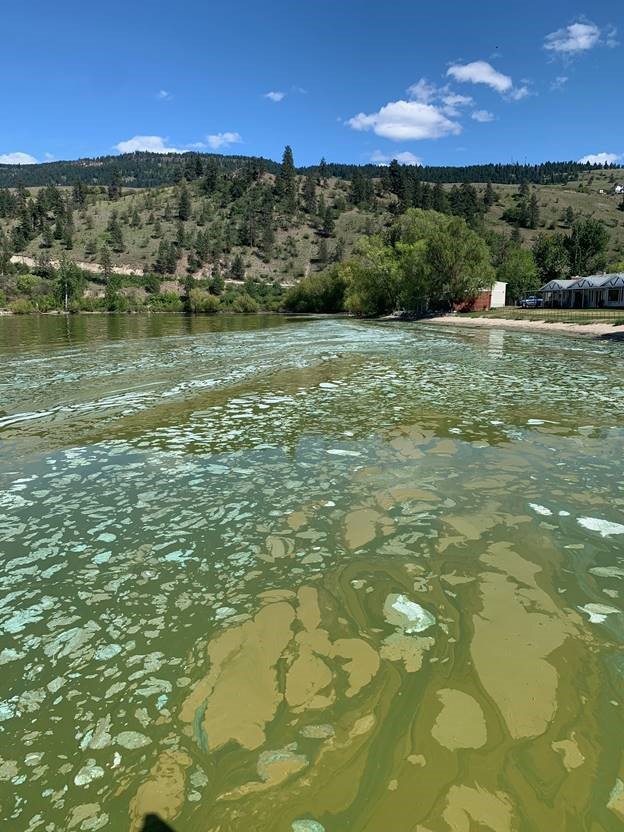

Public health practitioners work to identify new and emerging public health threats before they can impact communities on a large scale. We are supporting a project that is aiming to do just that: monitoring BC’s freshwater lakes for cyanobacteria blooms — also known as blue-green algae, that can cover the water’s surface like a blanket — and sounding the alarm to local communities before their members and animals are poisoned by the toxins these bacteria can produce.
The Opportunity
Cyanobacteria blooms are increasing in severity and frequency across BC’s over 20,000 lakes, due to the impacts of an increased population and climate change, like wildfire smoke and debris, and drought, that pollute the water and create a breeding ground for these blooms to grow. The health consequences of most cyanotoxins — produced by cyanobacteria— are not yet fully understood, but can range from gastrointestinal and respiratory symptoms, to liver damage and in rare cases, death. More research is required to understand longer term impacts such as neurotoxicity and cancer.
We DO know that cyanotoxins are deadly to birds and mammals — like our furry dog and cat companions — livestock, and wildlife. Cyanotoxins can kill plant and animal life in lakes, and blooms can suffocate fish, leading to mass kills of fish and broader ecosystem degradation. The blooms also have economic consequences, through impacts on fisheries, livestock, the tourism industry. They also prevent spiritual and cultural access to, and use of, traditional waters and food sources. Unfortunately, blooms are only currently monitored in a tiny fraction of BC’s lakes, so the health impacts — like the deaths of pets and livestock — often occur before blooms are recognized. Most bloom response occurs only after these health impacts have sounded the alarm to a problem in the environment.
The Solution
This emerging One Health threat, that has the ability to kill our companion animals, interrupt our food supply, and lead to adverse human health outcomes, is why we are proud to support Cyanobacteria Water Assessment Technology for Climate and Health (CyanoWATCH), a satellite surveillance project conducted by our partners at the BCCDC, the Cyanobacteria and Health Coordination Committee for BC (CHeCC-BC), and working in collaboration with the BC Ministry of Environment and Parks, and the BC Ministry of Water, Land and Resource Stewardship (WLRS). This project aims to monitor more of BC’s freshwater lakes for the appearance of cyanobacteria blooms. Currently, BCCDC and WLRS have developed a prototype cyanobacteria bloom surveillance dashboard that uses satellite imagery and previously published cyanobacteria detection algorithms to estimate the presence and intensity of blooms in more than 80 lakes across BC. Other existing monitoring programs rely on water testing which is more resource intensive, cannot be scaled to many lakes, and does not give a complete picture of blooms which can affect entire lakes and change over time.
CyanoWATCH will expand this work by developing new, state-of-the-art machine learning algorithms to detect cyanobacteria in satellite images, confirming the cyanobacteria with gold standard water testing, and incorporating them into the near-real-time reporting dashboard. Along with the new dashboard, the BCCDC’s Public Health Lab will establish cyanobacteria water testing capacity for confirmation and quantification at the provincial scale. Bytaking water samples to confirm the presence and concentration of different cyanobacteria species, researchers will understand more about the ecology and risk associated with different blooms. The team also plans to work with BC’s First Nations communities to prioritize lakes that have specific cultural, spiritual, food, or other significance to BC’s Indigenous Peoples. Ultimately, CyanoWATCH will allow for early detection of cyanobacteria blooms, and enable partners to provide early warning to communities and lake users about emerging and ongoing risks.
The Impact
This project takes an upstream approach — literally! — by monitoring for cyanobacteria blooms before human/animal health is impacted, and sounding the alarm to nearby communities, helping to protect animals (pets, livestock, and wildlife), BC’s tourism industry, our own health, and the health of communities across the province. The proliferation of these blooms is a direct impact of climate change. As such, this problem is only growing, and will continue to do so. To promote climate adaptation and resilience, increased impacts can be lessened through enhanced monitoring, and alerting before a large-scale events takes place, like an entire field of cattle dying, or a group of people experiencing an unknown illness after drinking or swimming in their local lake.
The Lead Researcher
Dr Michael Lee is a senior scientist with environmental health services at the BCCDC. He also holds appointments at the University of the Fraser Valley as a research associate with the Food and Agriculture Institute and as an adjunct professor with the Department of Planning, Geography, and Environmental Studies. His work is focused on developing and implementing applied research and surveillance programs to better understand and address the interconnected health of humans, animals, and the natural environment in British Columbia — the important One Health work that has become such an integral part of understanding emerging public health threats. Dr Lee’s portfolio includes cyanobacteria, urban rats, extreme heat, wildfire smoke, biotoxins, and other environmental health related issues.

“On a personal level, I became interested in this work with the emergence of the ‘mysterious brain disease’ investigations in New Brunswick. Cyanobacteria toxins were one of the hypothesized agents of that illness. There is emerging literature suggesting links between exposure to cyanotoxins and neurodegeneration more generally, but more research is needed. If we want to start doing that kind of health effects research in BC, we first need good data on exposure. This satellite surveillance work would be able to get us the data to start doing that research.”
Why Philanthropy Matters
The CyanoWATCH project will combine new machine learning methods with satellite imagery, near-real-time reporting and cutting-edge laboratory methods to vastly expand cyanobacteria surveillance across BC. This surveillance will enable proactive public health protection and facilitate longer-term research to identify and understand long-term health impacts on people. This groundbreaking work is not being funded by the federal or provincial government, and would not be made possible without the support of non-profits like the Foundation, and the generous donors who help support this work.
Please contact fundraising@pphf.ca If you would like to more information on how you can help protect our people, animals, and lakes from cyanobacteria blooms.