

As an organization that champions public health, we are always searching for more information about potential public health threats, and gathering the information our supporters should know to stay safe and healthy. November is Radon Action Month in Canada, so we went to the radon experts at BC Centre for Disease Control to tell us more about it, what the risks are, and how families can protect themselves from this health threat that is the leading cause of lung cancer for non-smokers.
What is Radon?
Jeffrey Trieu, Senior Epidemiologist, and Molly Mastel, Industrial Hygienist — both from Environmental Health Services at the BCCDC — kindly provided us with the info we need to protect ourselves from the impacts of radon.
Radon is a carcinogenic gas. It derives naturally in the ground (the soil and rock beneath us), from the radioactive decay of uranium. It can release from the ground, and enter the air around us and outdoors. If radon releases into a home, it gets trapped there with no way to be released into the atmosphere. According to Jeffrey, “Outdoors it dilutes to unproblematic concentrations, but the issue is indoor air, where long-term exposure is associated with the development of lung cancer. So really, it’s an indoor air quality issue.”
Radon Facts
- Radon is an odourless, colourless, tasteless gas.
- All homes have some level of radon gas. The only way to know if you have an unacceptable level — the Canadian guideline is anything over 200 Becquerels per metre cubed (Bq/m3) — is to test.
- Both older and newer homes can have radon.
- Even neighbouring homes can have different radon levels.
- Radon is known in public health circles as a silent killer. There are more than 3,200 radon-related lung cancer deaths in Canada each year.
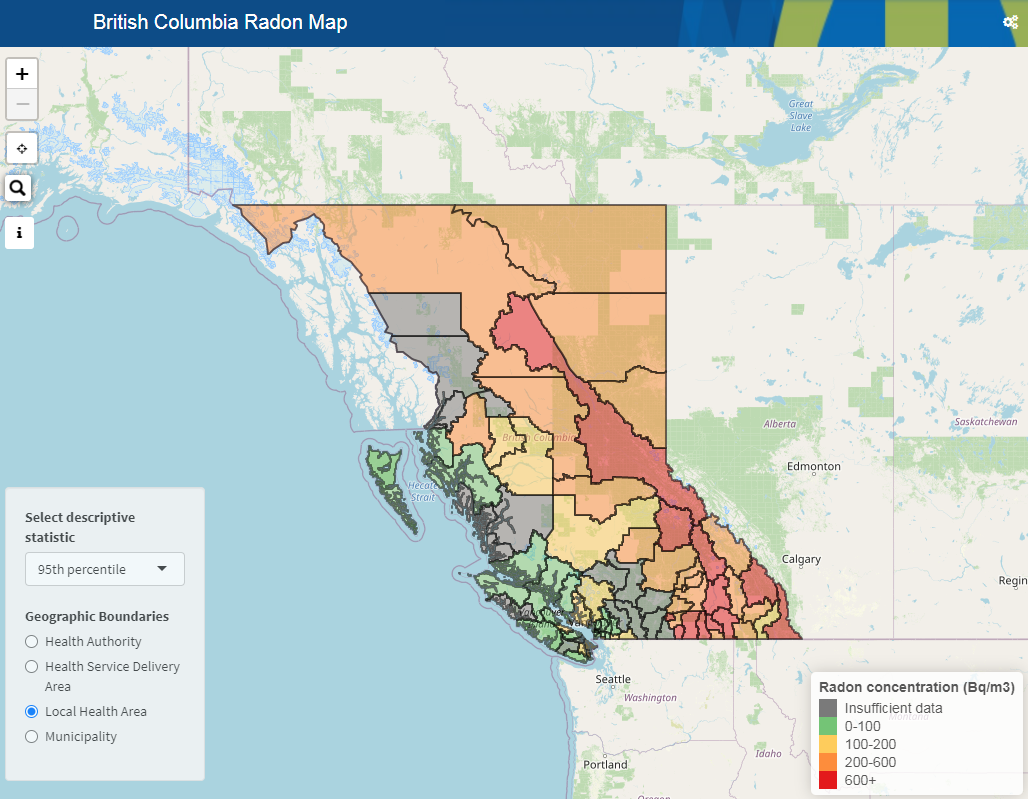
- Due to geological factors, some areas in BC have naturally higher surface levels of radon than others — many in the Interior and Northern BC. BCCDC has a radon map to provide more information about elevated risk areas.
- If your home tests positive for an unacceptable level of radon, there are many cost-effective ways to fix the problem.
Why Does Radon Cause Cancer?
Health Canada describes it in the following way: As radon breaks down, it forms radioactive particles that can get lodged into your lung tissue as you breathe. The radon particles then release energy that can damage your lung cells. When lung cells are damaged, they have the potential to result in cancer. Long-term radon exposure creates the risk.
As Jeffrey explains, “Often you have these cases of people who haven’t smoked their entire lives. They don’t have a family history of lung cancer, but unknowingly they’ve lived in a home with a high radon for 20-30 years and they’re 50-60 years old.”
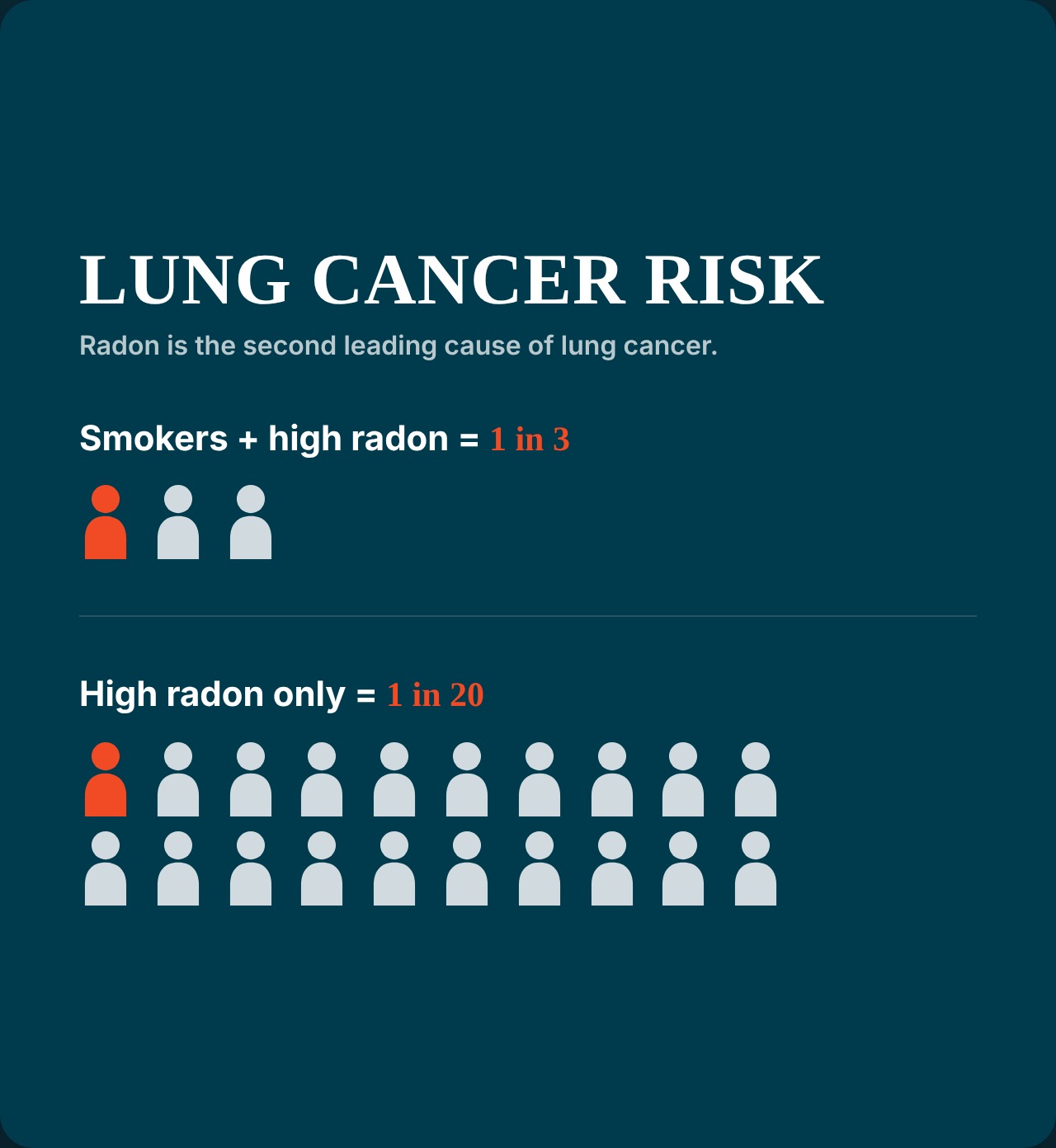
Health Canada estimates that a non-smoker exposed to high levels of radon over a lifetime has a 1 in 20 chance of developing lung cancer. For smokers exposed to the same level of radon, the chance increases to 1 in 3.
How to Test for Radon
Health Canada recommends that residents do a long-term radon test, for a minimum of three months, during the fall or winter, and that the detector is placed in the lowest level of the home where residents spend a minimum of 4 hours per day. Radon test kits are non-toxic and safe to use in homes with pets and children.
Molly tells us about the importance of testing your home for radon, no matter where you live. “Some people, especially in the Lower Mainland, really think of it as an issue elsewhere. And there is definitely an increased risk in different parts of the province, but that doesn’t mean that you are zero risk when you’re not in those high impact areas.”
If You Rent Your Home
The BC Lung Foundation offers a radon guide for British Columbia renters with a list of the current obligations of landlords, and the rights of renters in relation to radon.
If Radon is Detected, How Can the Problem be Fixed?
Jeffrey explains, “There are relatively simple and cost-effective means to reduce exposures in homes, things like (fixing) ceiling cracks and things like that.” A certified radon professional should be consulted, who will offer recommendations to help mitigate the level of radon in your home. If a mitigation system is recommended, the Canadian Lung Association has a grant program available that may help with the cost of radon mitigation.
Don’t Ignore the Risk of Radon
The risk of radon exposure may not seem like an imminent threat to your health, but the long-term exposure can potentially lead to adverse health impacts, like lung cancer. As Jeffrey points out, “Since there’s no immediate risk, I think it’s just human nature to say, oh I’ll forget about that. But the risk overall to one’s health is really meaningful. Lung cancer is one of the least treatable cancers out there, and we do have lung cancer screening programs for those with a smoking history or a family history, but not if people find high radon exposure in their home.”
————————————————————————————————
To learn even more about radon, go to knowvember.ca, and order a test kit for your home by visiting Take Action on Radon.
Photo Caption Option 1: Molly Mastel, Industrial Hygienist in Environmental Health Services at the BCCDC
Photo Caption Option 2: Molly Mastel, Industrial Hygienist in Environmental Health Services at the BCCDC, posing with a radon test (or different radon tests)

