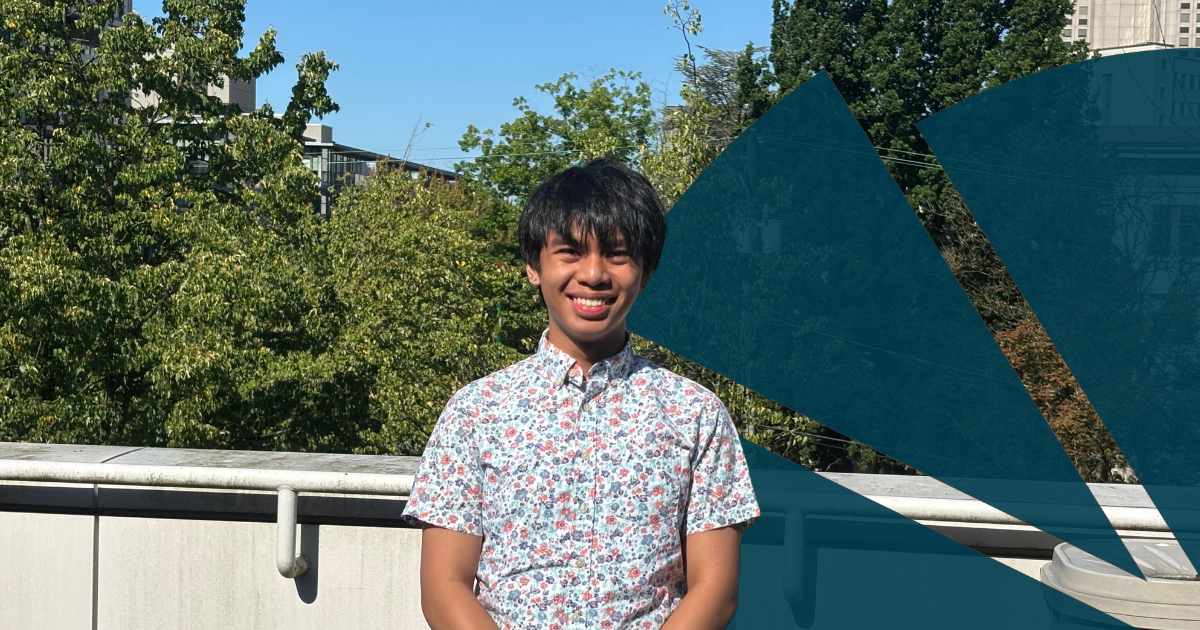
Ervin Cadiz’s upbringing in the southeast Burnaby neighbourhood of Edmonds inspired him to follow a journey of community service and activism, while leading with empathy and kindness. As a high school student at Byrne Creek Community School, he was taught to help not only other students, but their families as well. Through participation in the student government, he helped create clothing and food hampers for families, and helped form a student union to increase student representation in the community. “Within (Edmonds) there’s a large newcomer-to-Canada population, and a lot of gentrification of a low-income neighbourhood. If you’re a student there, you can’t ignore the society in which you live.”
He was recognized for his leadership in making a positive impact in his community with a TD Scholarship for Community Leadership in 2022, which provides recipients up to $70,000 for post-secondary tuition and living expenses as well as opportunities for paid summer employment. He is now a full-time psychology student at the University of British Columbia, and through his scholarship, Ervin was awarded an internship at the BCCDC’s Clinical Prevention Services, where he is working this summer with Dr Sofia Bartlett on the Test, Link, Call initiative — a program that TD Bank Group has also generously donated funds to support.
His previous experience interning with the Canadian Mental Health Association (CMHA) gave him the opportunity to do peer outreach, where he saw first-hand the challenges of working within a traditional healthcare setting. “I found a lot of my time at the CMHA, while it was amazing, was trying to work around the limitations within the system.” These limitations included things as simple as a lack of pamphlets in multiple languages for those who do not speak English, or waitlists for access to culturally-appropriate care. These barriers to care often disproportionately impact equity-deserving groups, such as those who are unhoused or have precarious housing, older adults, newcomers to Canada, Indigenous peoples, and those who have experienced criminalization.
This is why the public health system exists, to fill those gaps in care within the traditional healthcare system. “I thought, I’m sure there’s a better way to effect change… and I didn’t really know how that could happen until I joined the BCCDC for my internship here and started to learn about public health.”
One such program that fills a gap in traditional care is the Test, Link, Call program, which our Foundation has supported since its inception in 2021. This is a joint initiative between the BC Centre for Disease Control (BCCDC), BC Mental Health & Substance Use Services (BCMHSUS), BC Hepatitis Network, and Unlocking the Gates (UTG) Services Society. The aim of the program is to support individuals at risk for, or diagnosed with, Hepatitis C (HCV), Hepatitis B (HBV), HIV, or syphilis. The key populations served are from equity-deserving populations, such as people who experience criminalization, people who use drugs, people who are unstably housed, and Indigenous peoples. The program introduces a new model of community care that addresses inequities exacerbated by technology, demonstrating that something as simple as a phone can open up opportunities for people to access the care and services they need. Test, Link, Call provides participants with a free cell phone with a six-month calling and texting plan, as well as connection to a peer navigator. The program’s incredible success is due in part to the peer navigator support provided, and the trust developed with participants when providing them with the tools needed to support their personal health and wellness journey.
As of February 2025, 562 people have been given cell phones through the program, and 90% of participants are remaining in treatment. Approximately 57% of participants enrolled for HCV care have initiated curative treatment, compared to 52% among people who currently or previously use drugs in the 2020 BC Hepatitis Testers Cohort. This shows that the Test, Link, Call program is helping more people start curative treatment, compared to standard care. Participants of the program also note the additional benefit of having a cell phone include increased social connection, and an elevated sense of personal value.
“Test, Link, Call is an amazing way to break through the barriers, working directly with the community and vulnerable populations whose voices might not be valued as much within academia.”
Ervin is researching similar programs in other parts of Canada, to learn different methods to make the program even more impactful. From finding new ways to teach a diverse group of participants how to use the cell phones, to looking at other funding streams, and finding metrics to evaluate the benefits of the program. Ervin and his colleagues are looking to the future of Test, Link, Call — how it can help even more people, and potentially be expanded to support the treatment of those living with, or at risk for other diseases.
With research, clinical care, policy work, and many other career opportunities available in the public health system, Ervin hopes to one day apply his learnings to change mental health services in the province for the better. His contributions to his community have already made him a public health rock star, and with his continued hard work and caring, he already has what it takes to make his dreams a reality.
—————————————————————————————–
Donate today to bring up the next generation of inspiring public health professionals, who help important public health initiatives like the Test, Link, Call program succeed.