In 2007, the Truth and Reconciliation Commission of Canada began work that culminated in 94 calls to action. These calls to action help guide our work, as we have a responsibility to uphold the rights of Indigenous Peoples in all that we do.
Call to action seven asks that educational and employment gaps between Indigenous and non-Indigenous Canadians be eliminated. This employment gap means that many industries miss out on the unique knowledge Indigenous Peoples have collected since time immemorial. This knowledge is particularly important in the public health realm, where more and more we see the One Health approach — where we recognize the health of people as closely connected to the health of animals and the environment — as essential for the future of healthy communities. This is what inspired our support of an internship program that places Indigenous students in Science, Technology, Engineering and Math (STEM) fields, where Indigenous representation is disproportionately low.
The seed2STEM research program for Indigenous youth not only provides paid summer internships for Indigenous youth, it also helps build self-esteem and mental well-being, and allows for the opportunity to solve some of our province’s most pressing public health concerns. We helped fund this program for the second summer in a row, and this year, we worked with our donor, Acuitas Therapeutics, to place five students at the BC Centre for Disease Control (BCCDC), who worked on a variety of interesting and impactful public-health related research projects.
Engaging Mentorship
Mentors like Dr Sofia Bartlett, interim scientific director for Clinical Prevention Services, and Dr Hind Sbihi, director of Data Science & Innovation for Data & Analytic Services, guided the students in their work, and accompanied them on field trips to scientific and cultural places of interest. The students were given opportunities to explore working in real STEM environments, with hands-on learning, and honed their public speaking skills by sharing their projects at a poster presentation at the end of the term.
Dylan, who is Nisg̱a’a and a recent high school graduate, was initially surprised to be placed at BCCDC, because his interests lie mainly in computer science. He was happy to learn through his work this summer that computers can be used to help study diseases as well. His project centred around the study of stigma and misinformation on social media platforms, and the harm this can cause to mental and physical health.
“I didn’t really expect to be put in public health I guess because my application was computer science focused. I definitely expressed interest in that. I’m like huh, the (BCCDC), I never really expected but there’s tons stuff to do here relating to computer science and I would say just be open to whatever your placement is because the organizers do know what they’re doing.”
Nicola, a member of the Nlaka’pamux Nation, used quantitative analysis to study the success of the Test, Link, Call program, a project that provides cell phones and peer support to equity-deserving people at risk for, or living with, Sexually Transmitted and Blood-Borne Infections (STBBI). Her research revealed a gender gap in the care continuum. She also noted that overall treatment enrollment has grown rapidly — with nearly half of all Test, Link, Call clients joining in the past 15 months — highlighting the ongoing need for accessible care solutions. “The Test, Link, Call project shows that providing mobile phones, combined with ongoing peer support, helps clients overcome barriers to accessing STBBI care.”
Nicola’s colleague Siena — of Kitigan Zibi Anishinabeg heritage and a recent high school graduate — studied testimonials from Test, Link, Call healthcare providers, peer health mentors, and program participants, to understand the barriers of using the apps that are pre-loaded on the phones and what can be done to facilitate easier use. “The phones are given to people with STBBIs — to people who don’t already have phones. They have lots of different apps on them, to access healthcare better. It can also help with reminders to take medications and other stuff. Lots of variety.”
Lessons in STEM and in Life
Adeline (Addy) studied the infection rate of congenital Cytomegalovirus (CMV), using the ELISA method, to help detect CMV in pregnant people, which can cause developmental issues in newborns. Addy was so inspired by her work that she created a Claymation video. Addy’s internship left her with a newfound confidence and belief in herself. “Seeing the world in a different lens while proving that I could do something that usually people think, okay, that’s way out of my league and I’ll never be able to do that. But I can prove to myself that I can do these hard things. Almost anything is possible. You can do anything (if you) put your mind to it.”
Deia, a Métis student going into grade 10, focused on something we are all familiar with since COVID-19 became part of our lives: face masks! She studied whether wearing a standard surgical mask for a prolonged amount of time can lower its efficacy, and concluded that this type of mask can be worn safely for up to 120 minutes.
This important work will continue at the BCCDC, with senior researchers applying the knowledge gathered by their student interns to continue working toward solving these public health issues. Perhaps these interns will return one day as colleagues, continuing their STEM careers. Whatever path they choose, we are grateful they spent the summer at the BCCDC learning from some of public health’s greatest minds, and impacting the health of our communities for the better. These types of innovative, equity-based programs are only made possible by our generous donors, and we are so appreciative of their support. If you would like to donate to support programs like this, that solve public health problems with new and unique perspectives, donate today.
———————————————————————————–
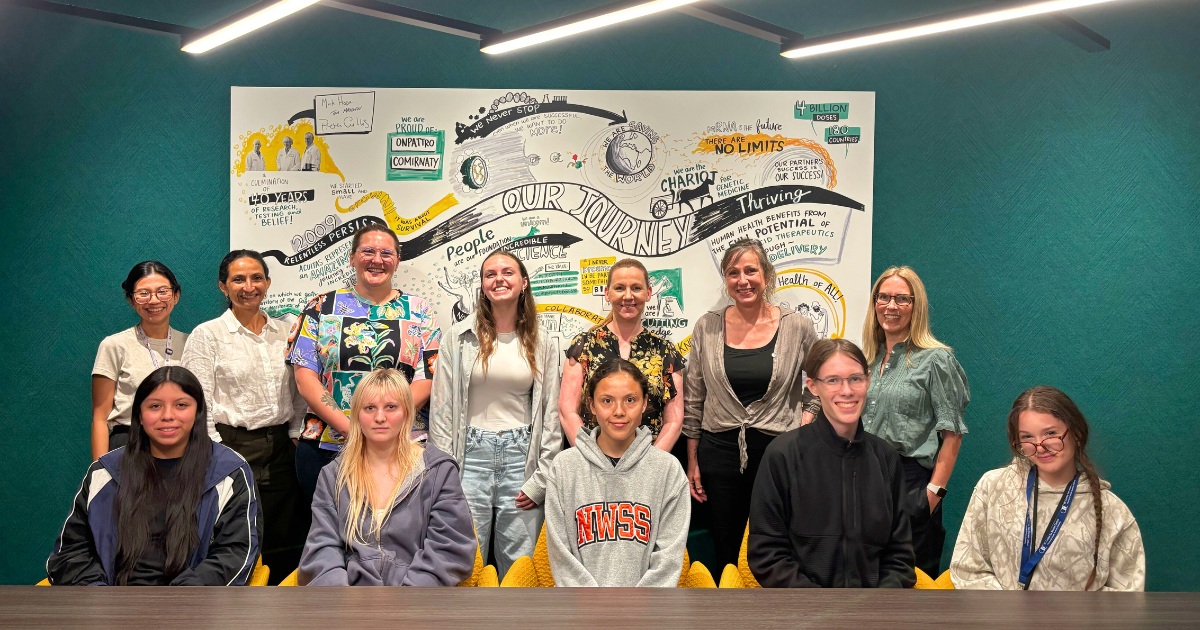
More about our donor: Acuitas Therapeutics’ mission is to advance human health through innovation. The team at Acuitas invited the students on a tour of their lab, where they create best-in-class lipid nanoparticle (LNP) delivery systems. Their LNP technology enables the COVID-19 vaccine COMIRNATY®, which has protected billions of people in more than 180 countries worldwide. Their accomplished employees shared advice on STEM careers with the interns, telling them that not only can they be successful in their careers, but their work can also help solve real-world public health problems, like the need for vaccines for new and emerging illnesses.